
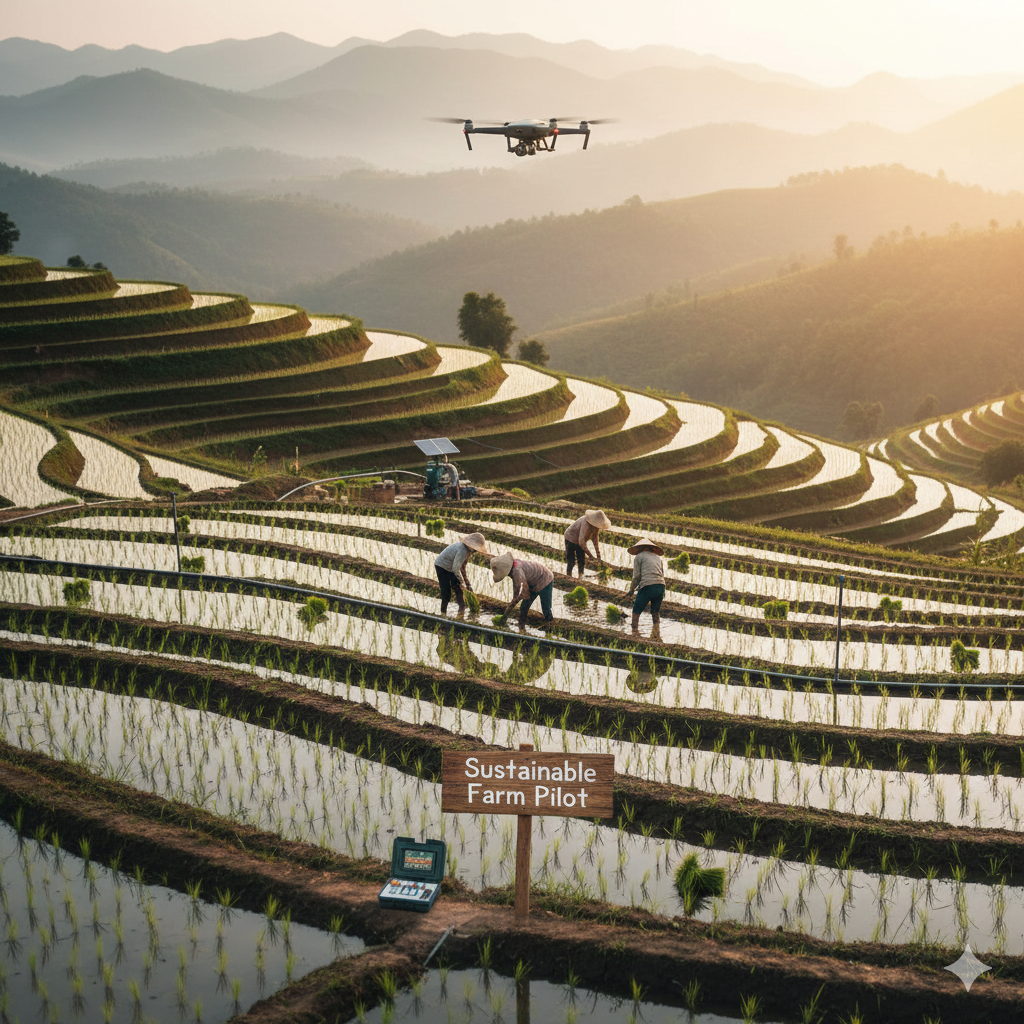
The Rise of Sustainable Farming in Asia and What International Buyers Must Know
The global demand for ethically sourced and environmentally responsible products is reshaping Asia’s agricultural powerhouse. For international buyers, the challenge has shifted from simply securing the lowest price to guaranteeing compliance, traceability, and certified sustainability at every point in the supply chain.
Asia is rapidly adopting green farming practices, driven by national mandates (like ISPO or MSPO for Palm Oil) and soaring European demand. Regulations like the EU Deforestation Regulation (EUDR) make rigorous, on the ground verification for importers a necessity. This transition offers incredible access to premium, sustainable materials but only for those buyers who partner for compliance.
At High Business International (HBI Group Asia), we view certification and traceability not as optional extras, but as non negotiable foundations for secure trade. Here is your essential guide to navigating the rise of sustainable farming across ASEAN, and what steps you must take to confidently Import Raw Materials Asia.
1: Green Farming & Low Carbon Practices (The How)
The core of Asia’s shift lies in moving away from traditional, intensive farming toward resource efficient and climate resilient methods:
- Precision and Smart Agriculture: Utilizing IoT sensors, drones, and data analytics to optimize resource use. For commodities like palm oil, this means reduced water and fertilizer wastage, maximizing efficiency while minimizing environmental runoff.
- Regenerative Agriculture & Agroforestry: Practices focused on improving soil health, increasing biodiversity, and sequestering carbon. Integrating trees into agricultural landscapes (agroforestry) enhances ecosystem resilience and provides diversified income for smallholders.
- Low Carbon Rice Cultivation: Methane reduction is a key focus. Techniques like Alternate Wetting and Drying (AWD) or controlled irrigation, often guided by the Sustainable Rice Platform (SRP), are essential practices in key Southeast Asian rice nations.
2: Decoding Asia’s Key Sustainability Certifications (The Proof)
The only way to verify these practices is through independent, internationally recognized certifications. Buyers must understand the difference between mandatory national standards and preferred global voluntary standards:
Mandatory National Standards (Palm Oil)
These government led schemes are mandatory for all domestic producers and ensure legality and basic environmental compliance:
- ISPO (Indonesian Sustainable Palm Oil): Mandatory since 2011, ensuring compliance with Indonesian law, labor rights, and environmental protection.
- MSPO (Malaysian Sustainable Palm Oil): Mandatory since 2019, covering environmental, social, and economic sustainability for all palm oil players in Malaysia.
Voluntary Global Standards (Preferred by Importers)
These standards often require more rigorous environmental and social criteria and are critical for accessing premium markets:
- RSPO (Roundtable on Sustainable Palm Oil): The leading voluntary standard, demanding full traceability, no deforestation, and strict social criteria. This is the most widely accepted certification globally.
- Rainforest Alliance: Focuses on biodiversity protection, climate action, and worker well being, commonly used for commodities like coffee and cocoa.
- ISCC (International Sustainability and Carbon Certification): Essential for products used in biofuels and feed, emphasizing GHG reduction and traceability.
3: Traceability and Eco Friendly Mills (The Assurance)
Traceability: The New Non Negotiable
The complexity of Asian supply chains, often involving thousands of smallholders and multiple intermediaries, makes achieving **Farm to Mill traceability** incredibly challenging. Yet, new regulations and market demands make this transparency a prerequisite for trade. The new standard is end to end provenance.
HBI addresses this using advanced digital tools and rigorous on site auditing. Our specialized verification solution, the Cooperate Gold Program, ensures compliance by providing digital, verifiable proof of origin. This includes:
- Origin Verification: We confirm the geographic boundaries of the source farms and overlay them with deforestation risk data.
- Real Time Tracking: We use tools like the Real Time Sourcing Tracker to maintain the integrity of source data from the farm gate to the mill.
- Mitigating Risk: By providing digital transparency, we eliminate the primary pitfall for buyers: relying solely on paper based certificates that risk commingling and fraud.
The Role of Eco Friendly Processing Mills
Sustainability doesnt end at the farm gate. Processing facilities must minimize their carbon footprint. Progressive mills are installing technologies like methane capture facilities to significantly reduce Greenhouse Gas (GHG) emissions. HBI integrates a QC audit to ensure that your product is ethically processed as well as meeting technical specifications.
Frequently Asked Questions (FAQ)
A: The main pitfall is relying solely on paper based certificates. The complexity of the Asian supply chain (multiple smallholders, many middlemen) creates high risk for commingling (mixing certified and uncertified product) and document fraud. Buyers must insist on end to end traceability systems that digitally link the final product to the verified farm coordinates.
A: The EU Deforestation Regulation (EUDR) requires EU operators to prove that their imports are deforestation free and were produced legally. This shifts the focus from simple certification to geospatial intelligence and verifiable land mapping (geolocation). For ASEAN exports, this means suppliers must provide proof of land legality and polygon mapping, which is a significant new data requirement.
A: The Roundtable on Sustainable Palm Oil (RSPO) is the most widely recognized international standard. National standards (ISPO, MSPO) exist because producing nations have mandatory local compliance schemes. International buyers often require the RSPO’s more rigorous social and environmental criteria to meet consumer and legislative demands.
A: There is often a premium associated with verified sustainable products. The cost is justified by mitigating catastrophic reputational and regulatory risk (fines, boycotts). Furthermore, sustainable practices often lead to more stable long term supply and better yields for farmers, protecting the buyer’s long term access to reliable, high quality sources.
A: Yes, but it requires technology and reliable third party engagement. HBI addresses this by working with certified cooperatives, using GPS and satellite imagery for land use verification, and implementing a Real Time Sourcing Tracker that maintains the integrity of source data from the farm gate to the mill.
Your Partner in Sustainable Sourcing
The move toward certified, sustainable agriculture in Asia is a massive, complex transition. It creates unparalleled opportunities for buyers to secure high quality products that meet global ethical standards.
Dont risk your brands reputation on unverified sourcing claims. HBI Group Asia provides the critical link: certified, end to end verification and supply chain management that guarantees your imported products meet the highest environmental and social standards from the farm to your port. Partner with us for guaranteed export import success.