
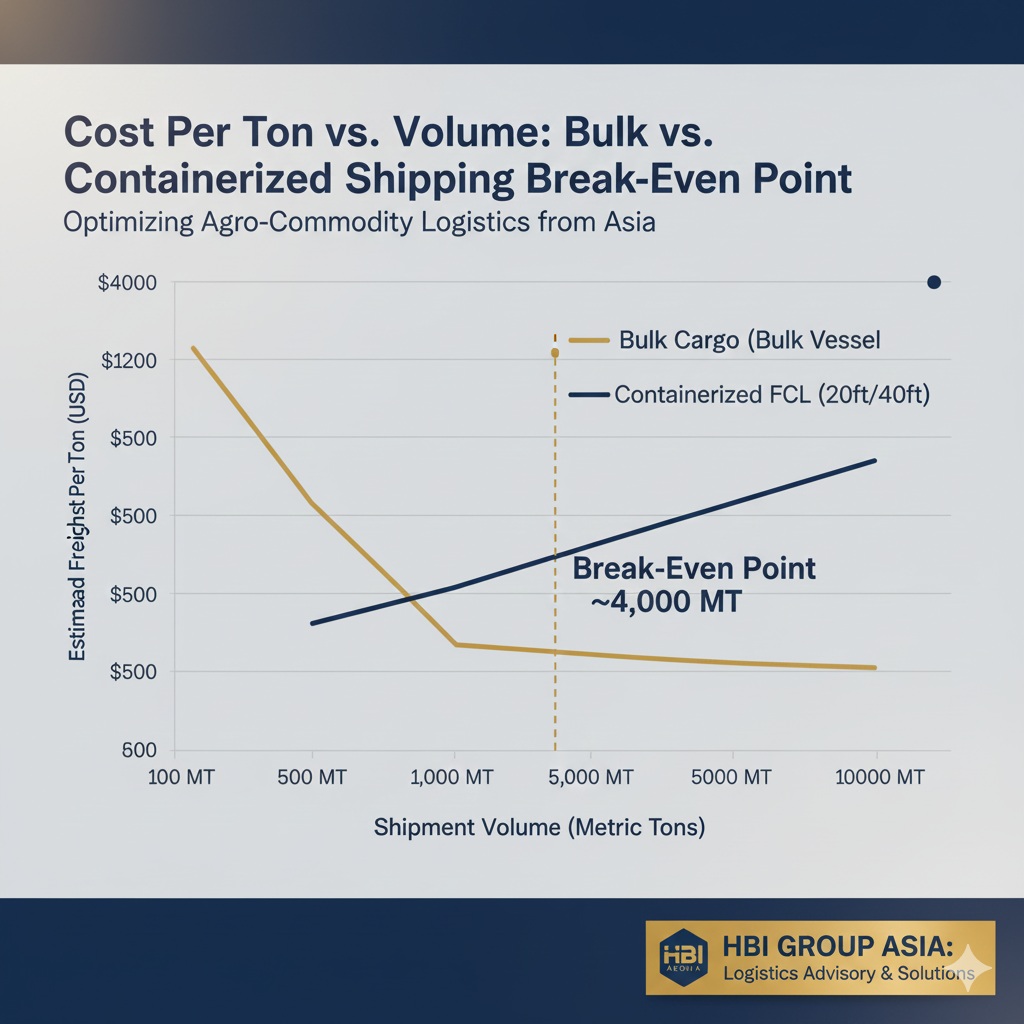
Bulk Cargo vs. Containerized Shipping: Ultimate Cost Guide
Choosing the right shipping method—**Bulk Cargo** (Bulk Vessel) or **Containerized Transport** (FCL/LCL)—is the single most significant factor impacting the final landed cost and operational risk of your agro-commodity import. The best choice is not universal; it depends entirely on your commodity, volume, and tolerance for logistics risk. **Therefore**, understanding the true cost of **Bulk Cargo vs Containerized Shipping** is paramount.
For importers, making the wrong choice can inflate costs by 15-30% or expose your cargo to unnecessary quality degradation. **Crucially**, this guide breaks down the core differences, costs, and ideal commodities for each option.
1. 📊 Quick Comparison: Bulk Cargo vs. Containerized Shipping
To immediately address the core question, here is a breakdown of the key differences:
| Feature | Bulk Cargo (Bulk Vessel) | Containerized (FCL/LCL) |
|---|---|---|
| Ideal Volume | High Volume (5,000+ MT) | Low to Medium Volume (1–1,000 MT) |
| Unit Cost | Lowest Cost Per Ton | Higher Cost Per Ton |
| Risk of Contamination | High Risk (Shared hull space) | Low Risk (Sealed unit) |
| Ideal Commodities | Feed Grade Grains, Fertilizers | High-Value Grains, Spices, Coffee |
2. 🛳️ Bulk Cargo: High Volume, Low Cost Per Ton
Ideal Commodities and Freight Differences
Bulk cargo refers to commodities shipped unpackaged in large quantities directly within the vessel’s holds. **Furthermore**, this is the standard for low-value, high-volume industrial goods like Feed Grade Grains (such as Feed Corn) and Crude Oils (like CPO).
- **Cost Efficiency:** You eliminate the costs associated with bagging, stuffing, stripping, and container rentals. The savings are substantial above 5,000 MT.
- **Logistical Risk:** Discharge is slower and requires specialized port equipment. For complex Operations and Logistics Management, this method requires dedicated expertise.
- **Quality Risk:** It’s often impossible to separate commodities from different suppliers within the same hull, increasing the risk of commingling and quality issues. **Conversely**, this risk is negligible in **Containerized Shipping**.
3. 📦 Containerized Transport: Security, Flexibility, and Quality Control
Security, Flexibility, and Cost Comparison
Container shipping, typically via FCL (Full Container Load), involves packaging the commodity into a sealed 20ft or 40ft container. **In contrast** to bulk, this method is preferred for any commodity where quality, hygiene, and brand integrity are paramount. You can find out more about sourcing High-value grains (Jasmine Rice, Basmati) on our site.
- **Security & Quality:** The container acts as a dedicated, sealed warehouse. Once loaded and inspected (ideally with SGS Pre-Shipment Inspection), the risk of contamination or tampering is drastically reduced. This is a critical factor in Fraud Prevention.
- **Flexibility:** Containers offer seamless door-to-door logistics, often defined by INCOTERMS like FOB or CIF. For real-time monitoring, tools like Track Bridge Connect provide visibility on the sealed unit.
- **Cost vs. Value:** While the cost per ton is higher due to container rental and handling, the total cost of ownership (reduced losses, minimized quality claims, and faster delivery) often makes it the superior choice for high-value food-grade agro-commodities. **Ultimately**, for technical specifications, consult the World Shipping Council on container standards.
4. 💡 The Final Choice: Bulk Cargo vs Containerized Shipping
The choice boils down to your Volume vs. Value equation:
- **High Volume / Low Value:** If your shipment is over 5,000 MT and consists of low-value, bulk-processed goods (e.g., animal feed corn, industrial palm oil derivatives), **choose Bulk Cargo**.
- **Low-to-Medium Volume / High Value:** If your shipment is under 5,000 MT and consists of premium, high-spec food grade items (e.g., Basmati rice, specialty coffee, spices), **choose Containerized FCL**.
HBI Group Asia Insight: We manage all logistics for our clients, from FCL to dedicated vessels. Large-scale importers benefit from our Cooperate Gold Program which optimizes the most complex, high-volume shipping needs. We use the most appropriate method to ensure both competitive pricing and absolute cargo integrity.